

Table of Contents
- The Five Basic Tastes: Your Flavor Foundation
- How to Balance Flavors with Salt: Beyond the Shaker
- Using Acid to Balance Flavors and Brighten Dishes
- The Role of Fat, Sweetness, and Heat in Flavor Balance
- How to Use Spice Blends Effectively for Layered Depth
- How to Fix Over-Salted Food: Quick Rescue Techniques
- Troubleshooting Flat or Heavy Dishes by Flavor Type
- Conclusion: Trust Your Palate and Cook with Confidence
- Frequently Asked Questions
Last Updated: September 8, 2026
Learning how to balance flavors in home cooking is the single skill that separates food that merely fills you up from food people remember. Every great dish relies on harmony among the five basic tastes. At Goodness Gracious Seasoning Blends, we build every one of our spice combinations around this idea, because a thoughtful blend does the balancing work for you before the pan ever hits the stove.
The good news is that you do not need a culinary degree to master this. Taste is a skill that improves with a little knowledge and a lot of practice. Below, we will walk through the mechanics of each taste, how they interact, and the specific techniques you can use to rescue a dish that has gone off the rails.
The Five Basic Tastes: Your Flavor Foundation
Flavor balance begins with understanding the five basic tastes your palate can detect: sweet, sour, salty, bitter, and umami. But to truly master balance, it helps to know what is happening on your tongue, not just what your brain tells you.
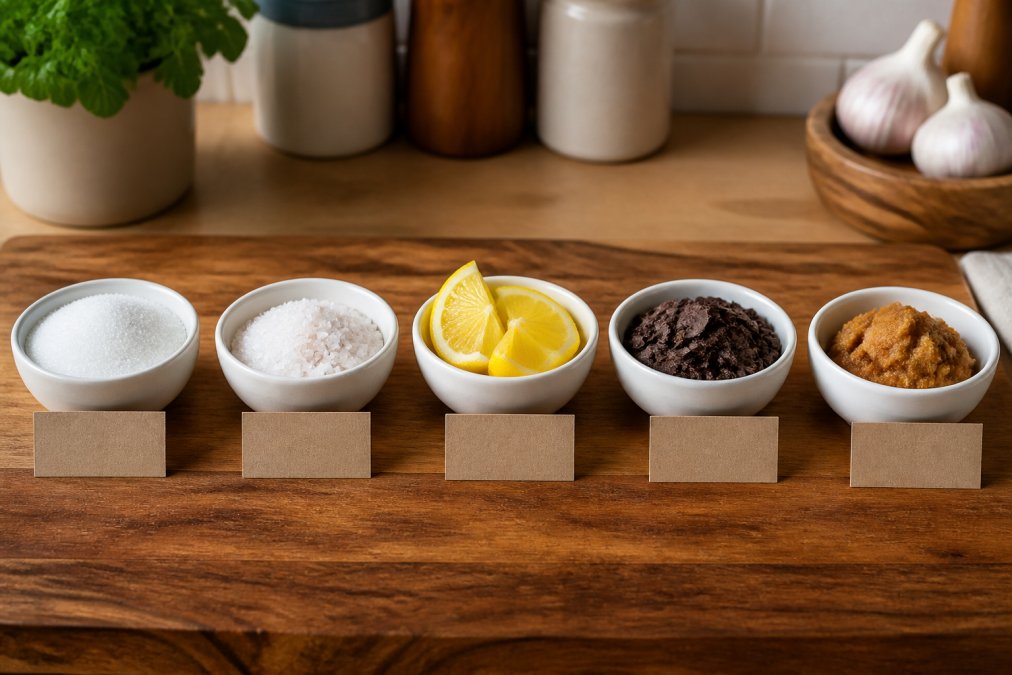
Your taste buds are clusters of receptor cells, each tuned to detect specific molecules that trigger signals to your brain.
Consider salt. Sodium ions are the smallest taste-related molecules, and they slip into receptor cells with ease (PubMed). This is why salt is so effective at amplifying other flavors: it lowers the threshold at which other taste receptors fire, making sweetness taste sweeter and bitterness less harsh (peer-reviewed research). This is a measurable, physiological effect, not a culinary myth.
Acid, on the other hand, works by releasing hydrogen ions. These ions directly stimulate sour receptors and also increase the perception of saltiness, which is why a squeeze of lemon can make a dish taste more seasoned even without adding more salt. This is the scientific basis for the classic chef's trick of finishing a sauce with vinegar.
Bitterness is the most sensitive of the tastes, and for good reason: many toxic compounds are bitter. Your palate is wired to detect bitter molecules at incredibly low concentrations, which is why a small amount of burnt garlic can ruin an entire dish. To balance bitterness, you need to either block the receptor (which salt does) or add competing signals (which sweetness and fat do).
Umami, the savory taste from glutamates, works differently. It binds to specific receptors that are also triggered by certain nucleotides found in meat and fish. This is why combining umami-rich ingredients like mushrooms and soy sauce creates a flavor that is greater than the sum of its parts: the glutamates and nucleotides amplify each other's signals in a synergistic effect.
This foundation explains why certain pairings work across all cuisines. When you understand these interactions, you stop guessing and start engineering flavor with intention.
How to Balance Flavors with Salt: Beyond the Shaker
Salt is the most powerful tool for balancing flavors, yet it is also the most misused. Proper salting suppresses bitterness, enhances sweetness, and amplifies the natural character of your ingredients.
The most common mistake is under-salting during cooking and over-salting at the table. Salt needs time to dissolve and penetrate, so season in stages: add a pinch when you start your aromatics, another when the main ingredient goes in, and taste before you finish. This gradual approach builds depth of flavor that surface seasoning cannot replicate.
Season, taste, and adjust with a clean spoon each time. Remember that cold food needs more salt than hot food because temperature dulls perception. If you are using a spice blend that already contains salt, account for it before adding more.
Using Acid to Balance Flavors and Brighten Dishes
Acid is the secret weapon for balancing flavors that most home cooks overlook. A splash of lemon juice, a dash of vinegar, or a spoonful of yogurt can lift a heavy dish, cut through fat, and wake up dull flavors. Using acid to balance flavors is the fastest way to make food taste more vibrant and professional.
When a dish tastes flat, the problem is rarely a lack of salt; it is usually a lack of acidity. Acid provides the contrast that makes other flavors pop.
Add acid at the end of cooking for maximum brightness, as heat can dull the sharpness of citrus and some vinegars. Start with less than you think you need; you can always add more, but you cannot remove it.
The Role of Fat, Sweetness, and Heat in Flavor Balance
Fat, sweetness, and heat round out a dish's flavor profile. Fat carries flavor and provides mouthfeel, coating your palate. Sweetness softens acidity and bitterness, while heat adds a physical sensation.
A sauce that tastes harsh or sharp benefits from a pat of butter or a swirl of cream. A tomato sauce that is too acidic benefits from a pinch of sugar or some finely grated carrot. A dish with too much chili heat can be tempered with dairy, a touch of sweetness, or more acid, each counteracting the burn differently.
Use these elements as corrective tools, not masks. Fat should enrich, not hide; sweetness should round out, not candy-coat; heat should excite, not overwhelm.
How to Use Spice Blends Effectively for Layered Depth
Spice blends are one of the most efficient ways to build complex, layered flavor without a pantry full of individual jars. A well-constructed blend already contains the salt, aromatics, and warm spices that create depth.
How to use spice blends effectively comes down to timing and technique. Toast dry spices briefly in the pan to release their essential oils before adding liquid. Bloom ground spices in hot oil with aromatics for a deeper result. Add blends in stages: a portion early for backbone and a portion near the end for a fresh finish.
A quality blend does more than add flavor; it simplifies the entire process of balancing a dish. When the blend is thoughtfully composed, you need fewer individual corrections.
How to Fix Over-Salted Food: Quick Rescue Techniques
Even experienced cooks occasionally overshoot the salt, but knowing how to fix over-salted food saves the meal. The most reliable method is dilution: add more unsalted base ingredients to spread the salt across a larger volume.

For soup or stew, a peeled raw potato simmered for fifteen minutes can absorb some salt, though its effectiveness is debated. A more dependable approach is adding acid like lemon juice or vinegar, or incorporating dairy like cream or yogurt.
If you cannot dilute further, serve the dish with something neutral, like rice or mashed potatoes. The goal is to bring the dish back into a range where the salt reads as seasoning, not as a flaw.
Troubleshooting Flat or Heavy Dishes by Flavor Type
When a dish tastes wrong, the fastest path to fixing it is diagnosing which taste is out of balance.
Start by asking: Is the dish flat, or is it heavy? Flat means flavors are muted. Heavy means one element is dominating.
If the dish is flat:
- Taste it cold and then hot. If it tastes flat at room temperature but better hot, the issue is likely salt. Add a pinch of flaky salt at the very end of cooking.
- If salt does not fix it, add acid. A teaspoon of lemon juice or white vinegar per cup of sauce is a starting ratio. Stir, wait 30 seconds, and taste again. Acid opens up the palate and makes other flavors more perceptible.
- If it is still flat, check for umami. A teaspoon of soy sauce, a splash of fish sauce, or a small piece of anchovy dissolved into the dish adds the savory depth that makes flavors linger.
If the dish is heavy:
- Heavy usually means too much fat or richness. Acid is your first tool. A tablespoon of vinegar or lemon juice per two cups of sauce will cut through the fat and lighten the mouthfeel.
- If acid is not enough, add a fresh element. Chopped herbs, a squeeze of citrus, or a handful of astringent greens like arugula can provide contrast that resets your palate.
- For a dish that is heavy from starch (like a gluey risotto or over-thickened stew), thin it with broth, not water. Water dilutes flavor; broth maintains it.
Specific dish failures and their fixes:
- Too salty soup: Add a peeled potato and simmer for 15 minutes. The potato absorbs some salt, though not all. For a more reliable fix, add a can of unsalted diced tomatoes or an extra cup of unsalted broth. If you have cream or coconut milk, a half-cup will coat the palate and soften the salt perception.
- Too bitter sauce (like over-reduced wine or burnt garlic): Add a teaspoon of sugar or honey per cup of sauce first. If bitterness persists, add a tablespoon of butter and whisk until melted. Fat coats the bitter receptors and mutes the signal. If it is still bitter, add a splash of cream.
- Too acidic tomato sauce: Add a pinch of baking soda (about 1/8 teaspoon per cup) (the NIH). It will fizz and neutralize some of the acid. Taste immediately. Alternatively, add finely grated carrot, which adds natural sweetness without changing the texture.
- Too spicy chili: Dairy is the most effective fix because casein binds to capsaicin molecules. Add sour cream, yogurt, or coconut milk. If you do not have dairy, add a spoonful of sugar or a squeeze of lime. Both distract the palate from the burn.
- Too sweet dessert or sauce: Add a pinch of salt first. Salt suppresses sweetness perception. If that is not enough, add acid: a teaspoon of lemon juice or a dash of vinegar. The acid provides contrast that makes the sweetness taste intentional rather than cloying.
Use this quick reference the next time a dish misses the mark:
| Problem | Likely Cause | First Fix to Try | Ratio to Start With |
|---|---|---|---|
| Tastes flat or dull | Under-seasoned | Add salt in small increments | 1/4 tsp per cup |
| Tastes one-dimensional | Missing contrast | Add a squeeze of lemon or splash of vinegar | 1 tsp per cup |
| Tastes greasy or heavy | Too much fat | Finish with acid or a fresh herb garnish | 1 tbsp per 2 cups |
| Tastes harsh or sharp | Too much acid | Add a pinch of sugar or a pat of butter | 1/2 tsp sugar or 1 tbsp butter per cup |
| Tastes overly bitter | Bitterness too dominant | Add salt first, then a touch of sweetness | 1/4 tsp salt, then 1/2 tsp sugar |
| Tastes one-note spicy | Heat without balance | Add dairy, sweetness, or more acid | 2 tbsp dairy per cup |
The most important habit is tasting as you go. Every adjustment gives you a reference point, so you can catch an imbalance before it becomes a problem.
Conclusion: Trust Your Palate and Cook with Confidence
Balancing flavors is not a secret technique reserved for professional chefs. It is a set of principles anyone can learn. Start by tasting more deliberately and making one small correction at a time.
The right tools make this process far more enjoyable. Thoughtfully sourced spice blends from Goodness Gracious Seasoning Blends simplify the balancing act by delivering layered, consistent flavor in every application. Pair them with our downloadable Flavor Secrets E-Cookbook, which includes over 40 recipes showing exactly how to use each blend, and you will have a reliable path to memorable meals every night of the week.

Get started with Goodness Gracious Seasoning Blends and turn everyday cooking into a confident, creative ritual.
Frequently Asked Questions
What is the 2 2 2 rule in cooking?
The 2 2 2 rule is a simple ratio some cooks use to build balanced vinaigrettes or marinades: two parts fat (like olive oil) to one part acid (like vinegar or lemon juice), plus a pinch of salt and sweetener. While it is not a universal law, it provides a reliable starting point for creating a balanced emulsion. Adjust the ratio to suit your taste or the dish, tasting as you go.
How do I fix a dish that tastes flat?
A flat-tasting dish usually lacks salt, acid, or both. Start by adding a pinch of salt and stir, then taste. If it still seems dull, add a squeeze of lemon juice or a dash of vinegar to brighten it. Umami-rich ingredients like a splash of soy sauce, a bit of miso, or a sprinkle of a savory spice blend can also add depth.
How do I use acid to brighten a heavy meal?
Acid cuts through richness and lifts heavy flavors. A squeeze of fresh lemon, a splash of red wine vinegar, or a spoonful of pickled juice added at the end of cooking can transform a dense stew or creamy pasta. Start with a small amount, stir, and taste. You can always add more, but you cannot take it out.
What are the five basic taste elements?
The five basic tastes are sweet, sour, salty, bitter, and umami. Sweetness balances heat and acidity. Sourness (acid) brightens and cuts fat. Salt enhances other flavors. Bitterness adds complexity. Umami provides savory depth. Balancing these elements is the core skill in home cooking. A well-seasoned dish uses several in harmony, with one or two as the leading notes.