

Table of Contents
- Why Your Food Tastes Bland (and It's Not Just Salt)
- How to Season Food Like a Chef: Timing, Layering, and Tasting
- Best Ways to Add Acid to Food for Bright, Balanced Flavor
- How to Use Dry Spice Blends Without Overwhelming a Dish
- Umami-Boosting Pantry Staples That Add Instant Depth
- Build Flavor With Equipment, Not Just Ingredients
- Conclusion: Fix Bland Cooking One Layer at a Time
- Frequently Asked Questions
Last Updated: September 10, 2026
Why Your Food Tastes Bland (and It's Not Just Salt)
Bland home cooking is rarely a salt problem alone. It's a balance problem: one of the four pillars of flavor has gone missing, or your palate has stopped registering what's there. At Goodness Gracious Seasoning Blends, we hear the same complaint constantly: "I followed the recipe and it still tastes flat." The recipe isn't the culprit. The finishing touch is.
You can salt a dish correctly and still end up with something dull. Salt makes food taste more like itself; it doesn't add complexity, brightness, or depth. Those come from the other pillars, so fixing bland home cooking starts with layering them in the right order.
The Four Pillars: Salt, Fat, Acid, Heat
Every well-seasoned dish balances four things: salt enhances, fat carries flavor, acid brightens, and heat (temperature and spice) creates contrast. Remove any one and the others feel muted. A tomato sauce with perfect salt but no acid tastes heavy; a roasted vegetable with good char but no fat tastes dry.
Most home cooks nail salt and neglect the rest. That's the single biggest reason a dish reads as bland even when it's technically "seasoned."
Flavor Fatigue: Why Your Palate Stops Noticing
Flavor fatigue is why the first bite of a stew tastes incredible and the tenth tastes like nothing. Your taste receptors adapt to repeated stimuli within seconds, which is why chefs taste, wait, and taste again rather than seasoning continuously (peer-reviewed research). If you've been sampling the same pot for an hour, step away for ten minutes or ask someone else to taste before adding more salt.
How to Season Food Like a Chef: Timing, Layering, and Tasting
Learning how to season food like a chef comes down to three habits: season early, season in layers, and taste at every stage. Chefs build the flavor profile from the first moment ingredients hit the pan, so the final dish needs only a light finishing touch.
Season in Layers, Not at the End
- During prep: Salt proteins 15-30 minutes ahead so seasoning penetrates rather than sitting on the surface.
- While sautéing: Add aromatics (onion, garlic, shallot) with a pinch of salt to draw out moisture and start caramelization.
- During deglazing: A splash of stock, wine, or vinegar lifts the browned bits (the fond) off the pan and back into the sauce.
- Before serving: Taste, then adjust with finishing salt, acid, or a fresh herb.
The rule of thumb: if you're only seasoning at the end, you're seasoning a surface, not a dish.
Best Ways to Add Acid to Food for Bright, Balanced Flavor
The best ways to add acid to food match the dish: citrus for brightness, vinegar for backbone, fermented ingredients for complexity. Acid is the most underused tool in home kitchens and the fastest fix for a dish that tastes heavy, muddy, or just "missing something."
Citrus, Vinegar, and Other Acid Sources
- Lemon and lime: Finish fish, vegetables, grains, and soups. Add zest for aroma without extra liquid.
- Vinegar: Red wine vinegar for beef and tomatoes, rice vinegar for Asian dishes, balsamic for reduction and drizzle.
- Fermented options: Sauerkraut, kimchi, hot sauce, and yogurt bring acid plus umami in one move.
Add acid in small amounts at the end of cooking, taste, then add more. A teaspoon of lemon juice can rescue a flat pot of soup without making it taste "lemony."
How to Use Dry Spice Blends Without Overwhelming a Dish
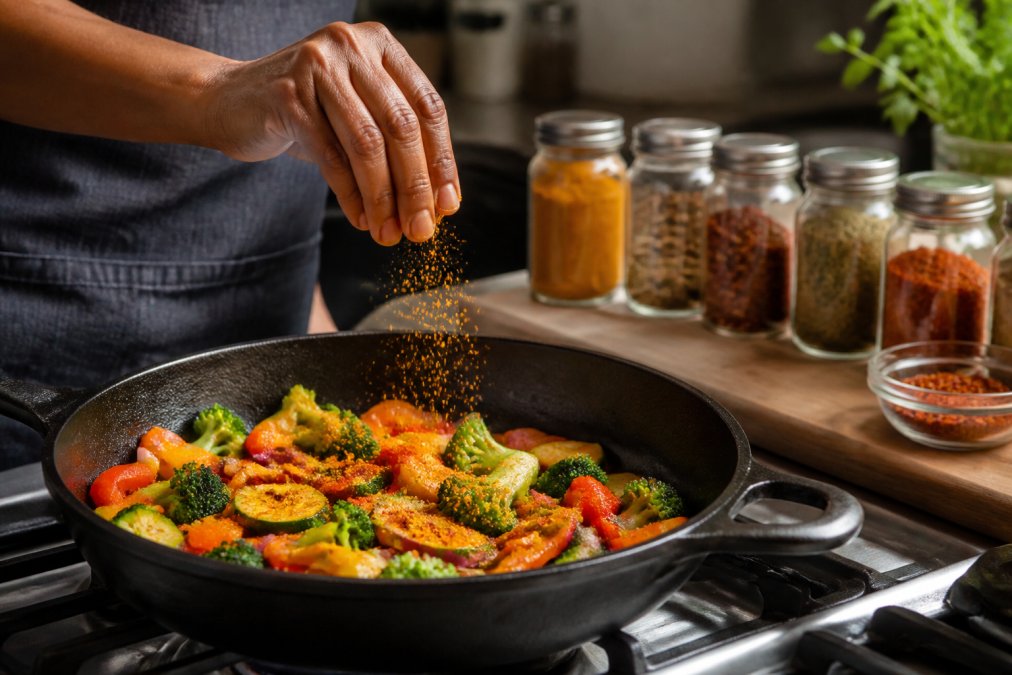
Using dry spice blends well means blooming them in fat, adding them early enough to cook but late enough not to burn, and tasting as you go. The most common mistake is dumping a blend in at the end, where it sits raw on top instead of melding in.
Why Blends Taste Different From Single Spices
A blend is a ratio problem. With one spice you adjust a single variable; with a blend, every pinch shifts the balance of five or ten spices at once, which is why blends go from "perfect" to "muddy" fast. The fix isn't to use less, it's to use the blend in stages.
The Blooming Window
Ground spices release their fat-soluble flavor compounds only when heated in fat (PubMed). That window is narrow:
- Below roughly 250°F: the spices warm but don't fully open up; you get aroma in the pan but not in the dish.
- Around 300-350°F: the sweet spot. Thirty to sixty seconds in shimmering (not smoking) oil is enough to wake up cumin, coriander, paprika, and most chili powders.
- Above 375°F: volatile oils burn off and bitter compounds form. This is the acrid, scorched note that ruins a curry or taco filling.
A practical test: when the spices smell fragrant and toasty but not sharp, pull the pan off the heat. If the aroma turns harsh, you've gone past the window.
Whole vs. Ground vs. Blend: A Timing Rule
- Whole spices (cumin seed, coriander seed, cinnamon stick, star anise) go in first, with the aromatics, and get 1-2 minutes in fat before anything wet enters the pan.
- Ground single spices go in after the aromatics have softened, for 30-60 seconds.
- Pre-mixed blends go in last of the three, for 20-30 seconds, because their finest particles (often paprika, garlic powder, onion powder) scorch first.
If a recipe tells you to add a blend "to taste" at the end, treat that as a finishing dust, not the main seasoning, the bulk should have gone in earlier.
How Much Is Too Much
A useful starting ratio for a pound of protein or vegetables is 1 to 2 teaspoons of a balanced blend, then adjust after tasting. Blends heavy on dried garlic, onion, or salt hit the palate faster than blends built on seeds and bark, so a salt-forward blend needs less. Read the ingredient list in order: whatever is listed first is the dominant note you'll taste most if you overdo it.
When a Blend Is the Wrong Tool
Blends are not universal. A blend built for roasted root vegetables tastes flat on delicate fish, and a citrus-forward seafood blend disappears in a long-simmered chili. Match the blend to the method: high-heat, short-cook dishes reward whole seeds and coarse grind; low, slow, wet cooking rewards finely ground blends that dissolve into the liquid.
A well-crafted blend like FriedRoastedBaked does the balancing for you: the herbs and spices are already proportioned so you're not guessing at ratios. If you're unsure where to start, the Flavor Secrets E-Cookbook walks through more than 40 recipes built around specific blends, so you can see exactly how much to use and when.


Umami-Boosting Pantry Staples That Add Instant Depth
Umami is the savory, mouth-filling quality that makes a dish taste "finished." A handful of pantry staples deliver it instantly: soy sauce, fish sauce, Worcestershire, tomato paste, mushrooms, Parmesan, anchovy paste, and nutritional yeast. They don't taste alike, but all add the same underlying savoriness.
The trick is using them where they belong. A splash of fish sauce in a beef stew disappears completely and leaves only depth. A spoon of tomato paste cooked into a mirepoix adds sweetness and body. Anchovy melted into garlic and oil becomes the backbone of a pasta sauce that tastes rich rather than fishy. According to USDA FoodData Central, these ingredients vary widely in sodium, so taste before you salt again.
Build Flavor With Equipment, Not Just Ingredients
Equipment changes how much flavor you can extract from the same ingredients. Most guides treat flavor as a recipe problem, when a meaningful share of it is a physics problem. The same garlic clove, peppercorn, or cut of meat tastes different depending on what you do it with.
Crushing vs. Chopping vs. Slicing
How you break down an aromatic determines how much of its volatile oil reaches the dish.
- Slicing ruptures the fewest cells, so the flavor is the most restrained. Sliced garlic in a quick sauté tastes sweet and mild.
- Chopping ruptures more cells and releases more allicin, the compound behind garlic's bite. Chopped garlic left to sit for 10 minutes before cooking develops noticeably more pungency.
- Crushing (with the flat of a knife, a mortar and pestle, or a press) ruptures the most cells and releases the most oil. This is why a smashed garlic clove in a pan of oil perfumes the whole dish, and why a garlic press makes a sauce taste sharper than the same amount of minced garlic.
A mortar and pestle tears and crushes rather than cuts, so cell walls collapse and oils pool on the surface. A spice grinder cuts cleanly but generates friction heat that drives off delicate top notes. For toasted cumin or coriander, a mortar and pestle yields a rounder, more aromatic result, but for large batches, the grinder wins on consistency.
Pan Material and the Sear
A heavy skillet develops more caramelization than a thin nonstick pan because it holds heat and recovers faster when cold food hits the surface. Add a room-temperature steak to a thin pan and the surface temperature drops, the meat steams in its own moisture, and you get gray meat instead of a brown crust. A heavy pan stays above the browning threshold, so the Maillard reaction, the reactions between amino acids and reducing sugars that produce the roasty, savory crust, actually happens.
Cast iron and carbon steel brown best. Stainless clad browns well and deglazes cleanly. Nonstick browns poorly because its surface is designed to prevent the sticking that browning depends on. Aluminum heats fast but unevenly. None of this requires buying new gear, it requires matching the pan to the job.
Surface Area and the Palate
A blender turns roasted vegetables into a silky soup with far more surface area for flavor to register on the palate. The same soup left chunky tastes less intense even with identical ingredients, because flavor perception depends partly on how much surface contacts your tongue and releases aroma into the back of your nose. That's why a pureed soup often needs less salt than a brothy one.
Resting, Reheating, and the Maillard Effect
Let a stew cool and reheat, and it usually tastes deeper: starch and protein continue to break down, and flavors that were separate while hot have time to marry. The Maillard reaction mostly happens during the original sear, but depth increases on reheating because the volatile top notes that dominated the first serving have mellowed.
The Tools That Actually Move the Needle
Ranked by flavor impact per dollar, the biggest wins are: a heavy skillet or Dutch oven, a mortar and pestle or spice grinder, a sharp knife (dull knives bruise herbs and crush cells unevenly), and a fine-mesh strainer for concentrating stocks. A multi-function appliance like the 1200W Multi-Function Kitchen Appliance handles noodles, dough, and sauces, freeing you to focus on seasoning rather than mechanics.

| Problem | Fast Fix | Why It Works |
|---|---|---|
| Tastes flat, not salty | Squeeze of lemon or splash of vinegar | Acid wakes up the palate |
| Tastes heavy or muddy | Pinch of finishing salt and fresh herb | Contrast resets perception |
| Tastes thin or watery | Reduction or spoon of tomato paste | Concentrates flavor, adds body |
| Tastes one-note | Bloomed spice blend in fat | Adds aromatic complexity |
| Tastes dull after reheating | Fresh acid and a fat drizzle | Restores brightness lost in cooling |
Conclusion: Fix Bland Cooking One Layer at a Time
Fixing bland home cooking isn't about one magic ingredient. It's about building flavor in layers: seasoning early, adding acid at the end, blooming spices in fat, and reaching for umami when a dish needs depth. Do that consistently and you'll stop chasing salt as the answer.
Goodness Gracious Seasoning Blends exists for exactly this moment. Our thoughtfully sourced, artfully blended spice combinations remove the guesswork, so a busy weeknight dinner still tastes like an occasion. Pair a blend with the Flavor Secrets E-Cookbook's 40-plus recipes, or grab a jar of FriedRoastedBaked for fish, chicken, beef, pork, and vegetables alike. Get started with Goodness Gracious Seasoning Blends and turn every meal into a ritual worth repeating.
Frequently Asked Questions
How do I fix food that already tastes bland?
Start with a pinch of salt and taste again. If it's still flat, add acid like a squeeze of lemon or a splash of vinegar. A teaspoon of soy sauce or a dash of fish sauce adds umami depth. For dishes that taste thin, finish with a small knob of butter or olive oil. Taste after each addition so you don't overshoot. Most bland dishes need two or three of these adjustments, not just more salt.
What is the 2 2 2 rule in cooking?
The 2-2-2 rule is a simple ratio for quick pan sauces: 2 parts liquid (like broth or wine), 2 parts fat (butter or oil), and 2 parts acid (vinegar or citrus). It gives you a balanced sauce without measuring cups. This works well for sautéing and deglazing, where you scrape up the browned bits from the pan and let the sauce reduce. Adjust the ratios to taste once you get comfortable.
Why does everything I cook taste bland?
Under-seasoning is the most common cause. Many home cooks add salt only at the end, so it sits on the surface instead of building into the dish. Seasoning in layers as you cook, tasting along the way, and using acid to brighten flavors makes a bigger difference than any single ingredient. Overcooked vegetables and meats also lose flavor, so watch your cooking times and temperatures.
How can I use spice blends to improve my home cooking?
Dry spice blends save time because the flavor balancing is already done. Use them as a rub on proteins before cooking, stir them into sauces, or sprinkle them over roasted vegetables. Start with one teaspoon per pound of meat or two cups of vegetables, then adjust. A blend like Goodness Gracious Fried*Roasted*Baked works on fish, chicken, beef, pork, and vegetables. The downloadable Flavor Secrets E-Cookbook has over 40 recipes showing how to use each blend.